
Carbon dioxide accumulation in poultry facilities represents a significant challenge that remains largely undetected without proper monitoring systems. This colorless, odorless gas affects bird performance, welfare, and profitability, particularly during winter months when ventilation rates are reduced to conserve heat.
Understanding the CO2 Challenge
Carbon dioxide is produced continuously through multiple sources within the poultry house environment. Bird respiration accounts for the primary source, with each bird exhaling CO2 as a metabolic byproduct. Additional CO2 generation occurs through microbial degradation of bedding material and operation of unvented heating systems.
The issue becomes critical when indoor CO2 concentrations exceed recommended thresholds. Research indicates that broiler houses should maintain CO2 levels below 3,000 ppm to support optimal bird health. However, this target proves challenging to maintain during cold weather operations.
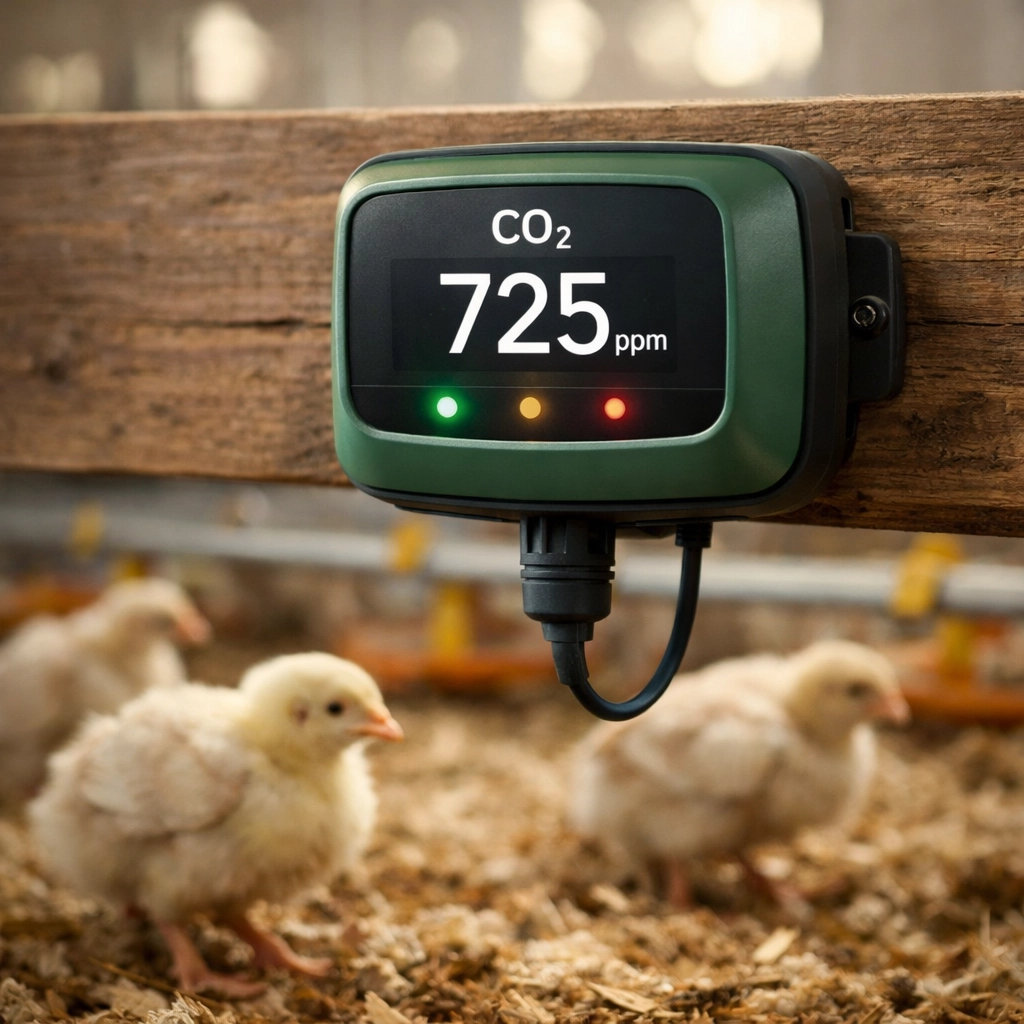
Winter Conditions and Elevated CO2 Levels
Winter presents particularly difficult conditions for maintaining acceptable air quality in poultry facilities. Producers face a fundamental conflict between heating costs and ventilation requirements. Reducing ventilation rates to minimize heat loss creates an oxygen-depleted environment where CO2, ammonia, and other harmful gases accumulate rapidly.
During winter operations, CO2 concentrations at bird level commonly reach 4,000 to 6,000 ppm, significantly exceeding recommended thresholds. These elevated levels reflect the practical reality of balancing thermal management with air quality requirements. Young birds demonstrate particular sensitivity to these conditions, with measurable impacts on performance metrics.
Studies examining CO2 effects on young poults reveal that birds exposed to 4,000 and 6,000 ppm CO2 show reduced body weight gain and decreased feed intake by the third week compared to birds maintained at 2,000 ppm. While older broilers aged 28 to 49 days appear more resilient to elevated CO2, the cumulative effects throughout the growth cycle warrant attention.
The Night Effect on CO2 Accumulation
CO2 levels fluctuate throughout the day-night cycle, with concentrations rising significantly during nighttime hours. This phenomenon occurs because photosynthetic activity that would normally consume CO2 ceases after dark. Without plants actively absorbing CO2, the gas accumulates more rapidly from continuous bird respiration and bedding decomposition.
Ventilation systems must account for this nocturnal rise in CO2 concentration. Facilities relying on fixed ventilation schedules may experience harmful spikes during night hours, particularly when outdoor temperatures drop and ventilation rates are minimized.
Cold Air Stratification and Floor-Level CO2
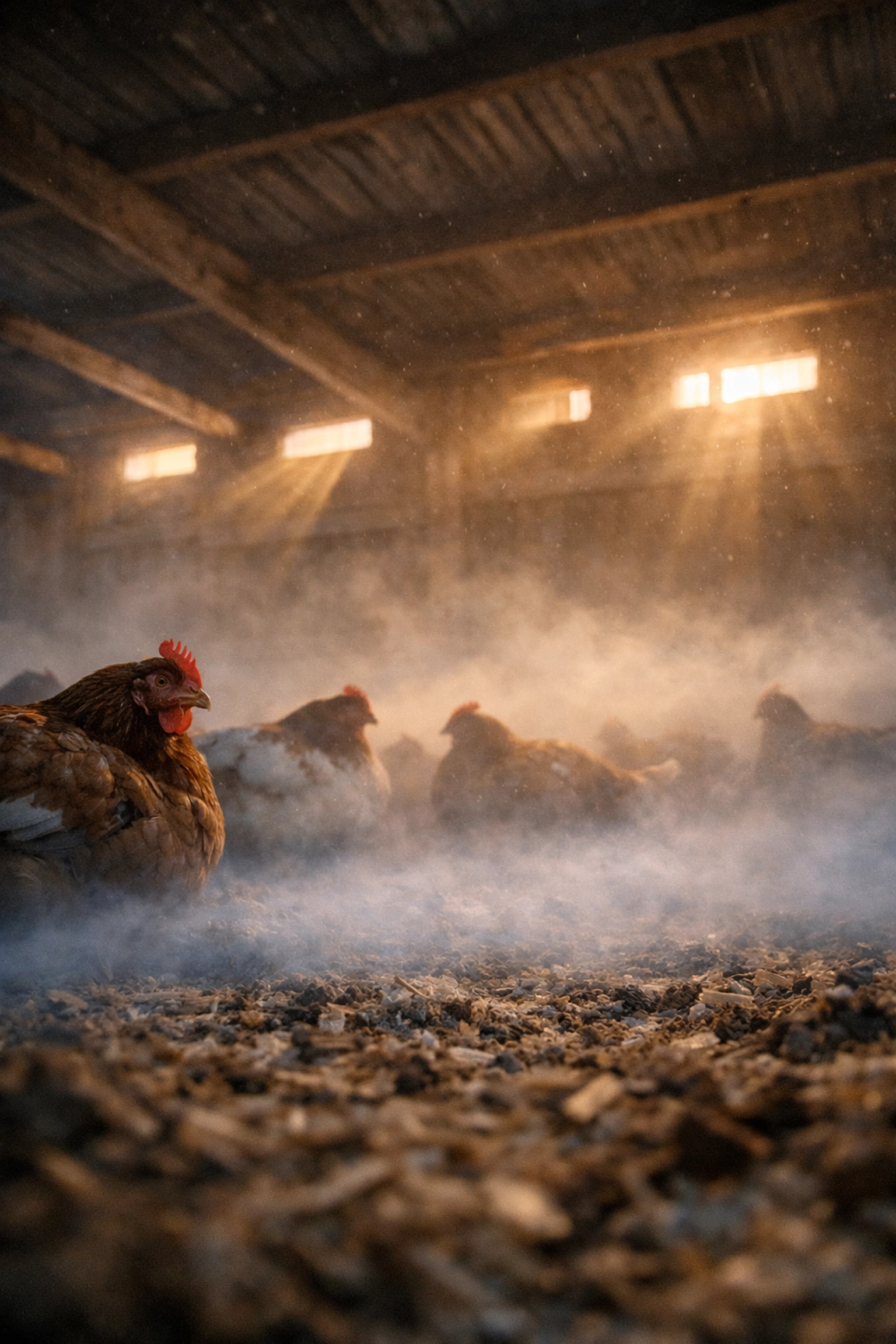
Temperature-related air density differences create a stratification effect that exacerbates CO2 exposure at bird level. Cold air possesses greater density than warm air, causing it to settle toward the floor. Since CO2 is also denser than air, it becomes trapped in this cold air layer near the ground where birds live and breathe.
This stratification phenomenon means that CO2 measurements taken at ceiling level or mid-height may significantly underestimate actual exposure concentrations at bird level. Birds spend their entire lives in the zone where CO2 accumulates most heavily, facing continuous exposure to elevated concentrations that may go undetected by improperly positioned sensors.
The practical implication requires placement of monitoring equipment at bird level to capture accurate CO2 readings. Measurements taken above the animal zone provide misleading data that can lead to inadequate ventilation responses.
Health and Performance Impacts
Elevated CO2 concentrations produce multiple adverse effects on bird health and performance. Beyond the reduced growth rates and feed intake observed in young birds, elevated CO2 increases the incidence of ascites, a serious condition causing fluid accumulation in the abdominal cavity.
Behavioral changes also manifest under high CO2 conditions. Birds exposed to lower CO2 concentrations demonstrate reduced movement compared to those in higher CO2 environments, suggesting altered activity patterns that may affect normal development and well-being.
The economic implications extend beyond direct performance losses. Increased mortality, reduced uniformity, and compromised immune function all contribute to decreased profitability. These effects compound when CO2 elevation occurs simultaneously with elevated ammonia and moisture levels, creating a synergistic negative impact on bird welfare.
Monitoring Solutions with emCo2
Effective CO2 management requires continuous monitoring with sensors positioned at bird level. The emCo2 sensor provides real-time CO2 concentration data, enabling producers to maintain target levels through timely ventilation adjustments.
Real-time monitoring allows the system to respond dynamically to changing conditions rather than relying on fixed ventilation schedules. When CO2 concentrations approach or exceed 3,000 ppm, the system signals the need for increased fresh air ventilation. This threshold-based approach ensures adequate air quality while minimizing unnecessary heat loss.
The wireless design of the emCo2 sensor simplifies installation and allows flexible placement at optimal monitoring locations. Multiple sensors can be deployed throughout the facility to capture spatial variations in CO2 concentration, ensuring comprehensive coverage of the entire bird zone.
Comprehensive Environmental Monitoring
While CO2 monitoring addresses a critical parameter, complete environmental management requires tracking multiple factors that interact to affect bird performance. The emBreath sensor complements CO2 monitoring by measuring temperature, humidity, and ammonia levels.
Temperature monitoring proves essential for understanding the stratification effect and ensuring uniform thermal conditions throughout the facility. Humidity tracking helps prevent moisture accumulation that promotes ammonia generation and respiratory challenges. Ammonia measurement provides early warning of excessive bedding moisture or inadequate ventilation.
Integration of data from emCo2 and emBreath sensors creates a comprehensive picture of environmental conditions. This multi-parameter approach enables more sophisticated control strategies that optimize multiple factors simultaneously rather than addressing individual parameters in isolation.
AI-Driven Ventilation Optimization
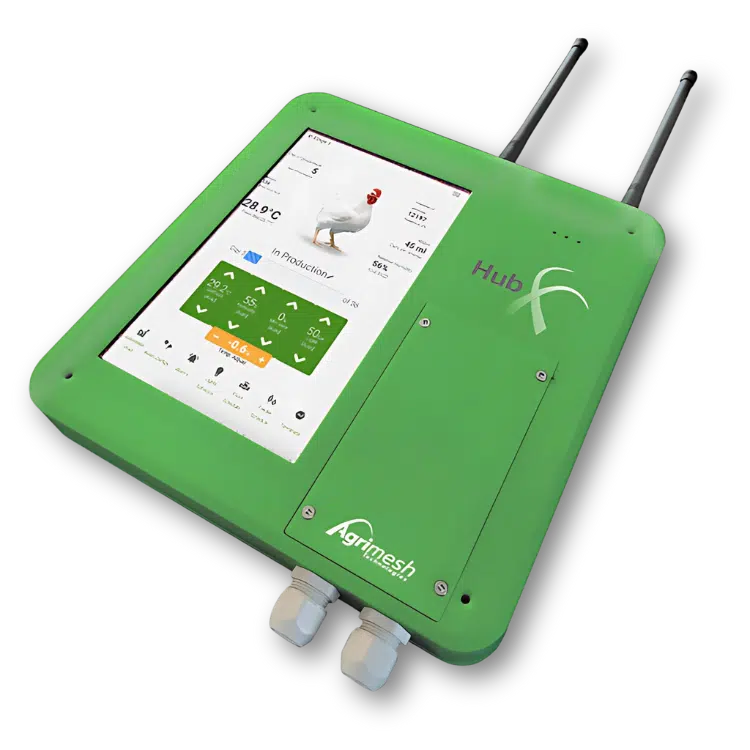
The Agrimesh platform processes data from emCo2, emBreath, and other sensors through artificial intelligence algorithms that continuously optimize ventilation strategies. The system learns facility-specific characteristics and responds to real-time conditions to maintain target parameters while minimizing energy consumption.
This AI-driven approach accounts for the complex interactions between CO2, temperature, humidity, and ammonia. The system anticipates changes based on time of day, bird age, outdoor conditions, and other factors, enabling proactive adjustments rather than reactive corrections.
Automated optimization reduces the burden on farm staff while improving consistency of environmental conditions. The system operates continuously, making hundreds of small adjustments that would be impractical through manual control. This results in more stable conditions, reduced environmental stress, and improved bird performance.
Access to historical data and trend analysis through the Agrimesh platform supports ongoing improvement of management practices. Producers can identify patterns, evaluate the effectiveness of changes, and refine their approach based on objective data rather than subjective observation.
Implementation Considerations
Successful CO2 management requires proper sensor placement, regular calibration, and appropriate ventilation capacity. Sensors must be positioned at bird level, avoiding locations near ventilation inlets or exhaust points that may give unrepresentative readings.
Ventilation system capacity must be adequate to achieve target CO2 levels under worst-case conditions. Facilities designed with minimal excess capacity may struggle to maintain acceptable air quality during extreme cold weather without compromising thermal management objectives.
Regular maintenance of heating systems and proper chimney installation prevent carbon monoxide accumulation, which compounds air quality problems when combined with elevated CO2. Unvented heaters should be avoided, as they contribute directly to CO2 buildup.
The integration of monitoring and control systems enables data-driven management that balances competing objectives. Rather than choosing between air quality and heating costs, producers can optimize both parameters simultaneously, achieving better outcomes at lower cost than traditional approaches permit.
